Rebuilt, card by card, from the 1997 set.
502 cards, one mark each. Point at a mark to see its card. Click it to read it.Tap a mark to read its card.
Every printed rule on these cards is read by an engine that knows what the text means. Two to four players, at one screen or across the wire.
- Tests
- 2,480, all passing
- Engine
- Godot 4.7
- Empty seats
- Played by the machine
Downloads
Unzip it and run it. Nothing to install and no account to make. macOS and Windows will both want telling that the file is safe the first time; the readme inside the zip says how.
Or play it in the browser: the same game, about 60 MB to load, made for a mouse and a keyboard. Decks built there are kept by the browser.
| Platform | What runs | Size | Published |
|---|---|---|---|
| macOS | ShadowrunTCG.app | 248 MB | 2026-10-15 |
| Windows | ShadowrunTCG.exe | 224 MB | 2026-10-15 |
| Linux | ShadowrunTCG.x86_64 | 212 MB | 2026-10-15 |
Play online
One server holds the tables. Open one, tell the others what it is called, and it deals when the last chair is taken. Each player brings their own deck.
wss://srtcg.oglimmer.com/ws
- Start the game and choose Play online.
- Put that address in the address field with your name, and connect.
- Pick a deck, then open a table or join one. A table seats two to four, and the machine can play as many of those seats as you like.
- If your connection drops, choose Rejoin. Your seat stays yours, nobody else can take it, and the table plays on while you are away.
What is in it
The rules, not a summary of them
Every card whose printed text names a rule has an effect the engine applies — or a written ruling saying how the text was read and why. Nothing is left to the player to remember.
One screen, nothing hidden
Four hands, four safehouses, an Objective row and the Challenge stacks, all on one screen with nothing scrolled away. Press T for the whole table at a size that reads.
The game lives on the server
A client is sent its own seat's view and nothing else, so no modified client can read a hand it was not dealt. Your seat is held by a secret only you hold.
How to play
The whole rulebook, in plain words. It is the same book the game opens when you press H. Where the 1997 rulebook and its later FAQ disagree, it says what the game does.
Every turn, the same six phases, in this order:
Start here
How to win
You are a fixer in 2050s Seattle. You hire Runners, send them against your opponents' Objectives, and bank the Reputation they bring home. First to the agreed Reputation total wins.
The target
Players agree the total before the game. 60–75 for two players, 75–100 for three or more, and never below 50 — so winning always takes at least two Objectives.
Setting up
- Take your 6 Objectives out of the deck, shuffle them, and put them face down as your Objective pile.
- Shuffle the rest, let an opponent cut it, put it down as your draw pile.
- Draw 7 cards.
- Put 4¥ in your Credstick.
- Decide at random who goes first. Play passes clockwise.
The Bad Shuffle
If your opening hand holds no Challenge at all, you may show it, trash it, reshuffle and draw a new 7. Once only, at the start of the game, and you are stuck with what you get.
Reputation below zero
Once your Reputation goes negative, ignore every further negative modifier. If it climbs back above zero, they start applying again.
Objectives you take from an opponent go back to them when the game ends. Nobody loses cards permanently.
Words to know
The Law of the Shadows
If a card contradicts the rulebook, the card wins. Every rule in this book is the default, and any card may rewrite it.
Turned and unturned
A card is turned — rotated sideways — to use it. That is the reminder that its owner cannot use it again this turn. Unturned means it is still available. Your Refresh phase unturns everything you control.
Deploy
To bring a card into play, paying its cost.
Nuyen and the Credstick
Nuyen (¥) is the money. Your Credstick is your pile of it. Almost every card costs nuyen to deploy.
The safehouse
The space in front of you. Your Runners, Contacts and Locations live there. A shadowrun happens outside it.
Sleaze
To slip past a Challenge without a fight, because the team has the skills it asks for.
Trash vs. frag
Trashed cards go to your discard pile, and the discard pile is shuffled into a new draw pile when yours runs out — so a trashed card comes back around. A fragged card is out of the game entirely and never returns. That is the whole difference.
Present
A card is present in exactly three situations: on a shadowrun (every Runner on the run, plus the Challenge currently revealed); in the safehouse (every unturned Runner there); or in Runner-against-Runner combat (both sides).
"User" vs. "target Runner"
User means the Runner using the card, never the player. Target Runner means the Runner chosen by the owner of the card doing the targeting.
"Until the end of the turn"
Always the turn of the player whose turn it was when the card was played.
Dice
D6. Modifiers can never push a roll below 1, and there is no upper limit.
Who goes first at the same moment
If two players want to play a card at the same instant, the player whose turn it is goes first. If it is nobody's turn, roll a D6 for it.
Info card
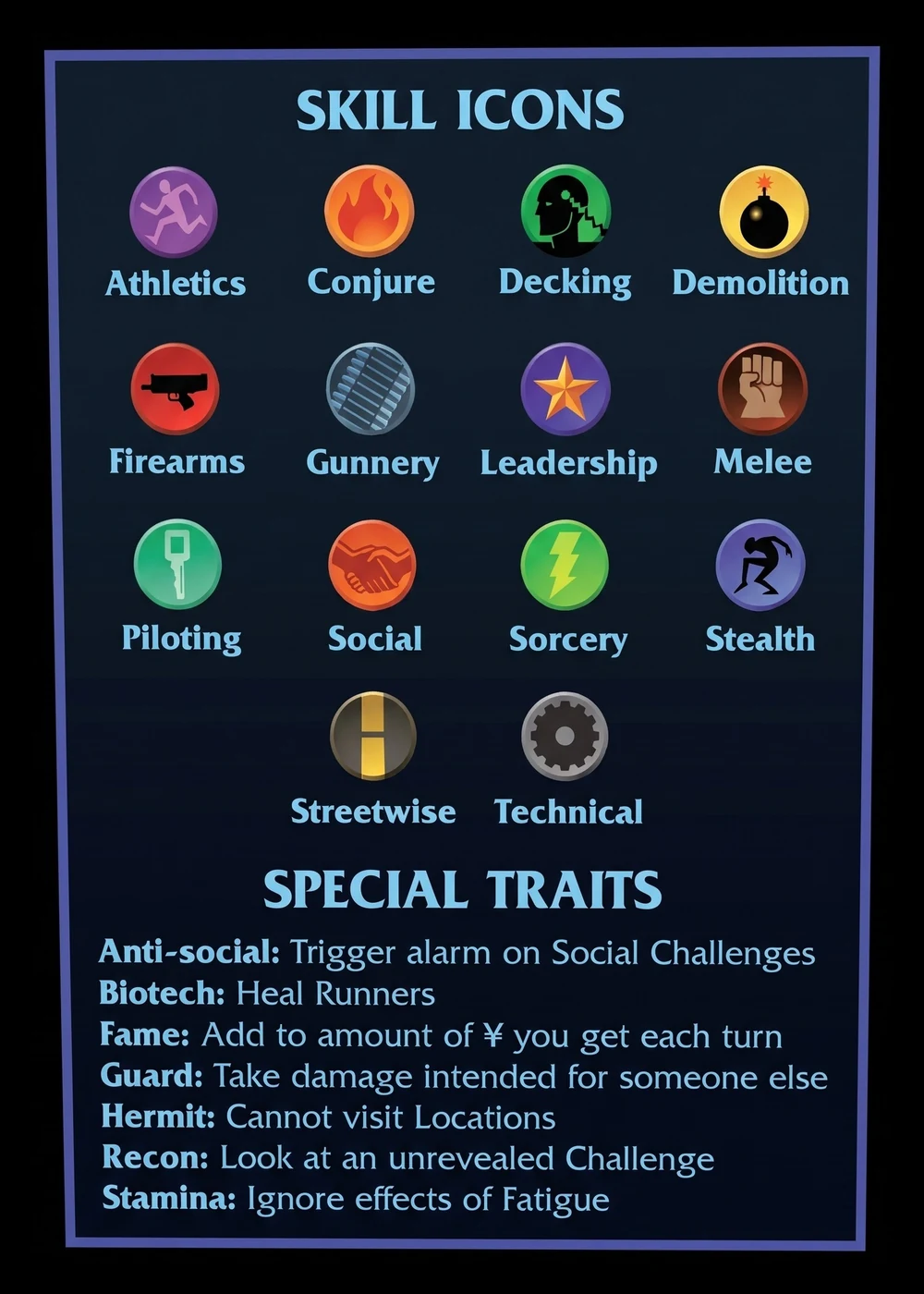
Every skill icon, and what each special trait does in one line. A disc alone is a rating of 1; a number beside it is the rating. Each trait has its own chapter under Special traits, with the whole rule. I opens this page from the board.
A turn
1. Objective phase
Put one Objective from your Objective pile face down in front of you. It stays face down until the start of your next turn, when it is revealed. Only a revealed Objective can be run against, so the face-down turn is the window your opponents get to stack Challenges on it. You may have only one Objective in play at a time. If it is taken or removed, you wait until your next Objective phase to place another.
2. Credstick phase
Payday, in this order:
- Take 4¥ — or, instead of the money, draw until your hand is back up to 7.
- Add bonus nuyen from cards in play (Fame on your Runners, some Contacts).
- Pay every Upkeep cost you owe. Upkeep is due even if you drew cards instead of taking the 4¥.
- Trash any card whose full Upkeep you cannot pay.
You start the game with 4¥ and collect 4¥ on turn one, so turn one has 8¥.
3. Refresh phase
- Unturn every turned card you control.
- Draw 1 card.
- Heal a Runner: turn a damaged Runner to remove all of its damage.
- Repair Gear: turn both the Gear and the Runner holding it to clear the Gear's damage.
One Runner cannot heal itself and repair its own Gear in the same turn.
4. Legwork phase
The phase where you play cards. Do any of these, any number of times, in any order:
- Play a Challenge onto any Objective in play.
- Deploy a Runner, Contact or Location into your safehouse.
- Put Gear on one of your Runners, or swap Gear between two of them.
- Use a Contact, a Location, a Runner or some Gear.
- Play a Special card.
Costs are paid before the card arrives. Deployed cards arrive unturned and can be used straight away. See Playing cards for the detail.
5. Shadowrun phase
At most one shadowrun per turn, and you may decline to run at all. At least one Runner must come home alive, or the Objective is not taken — even when the Objective asks for nothing. The moment the run ends, win or lose, you go straight to the End phase.
See The shadowrun for the full sequence.
6. End phase
- Say out loud that your Shadowrun phase is over. This is your opponents' last chance to play a Stinger or use an ability during your turn.
- Trash as many cards from your hand as you like.
- If you still hold more than 7 cards, discard down to 7.
- Declare the turn finished.
If the draw pile is ever empty, shuffle the trash and it becomes the new draw pile. There is no penalty for running out.
Playing
Playing cards
Playing Challenges
- A Challenge goes onto any Objective in play. Each player builds their own stack on their side of it.
- How many you may stack per Objective: 2 players → 3, 3 players → 2, 4 or more → 1.
- Each new Challenge goes on top, so a Runner team meets the last one played first.
- The number on each Challenge is its place. "1", "2", "3" is the order inside its own stack; the Objective's owner picks which stack comes first. "1st", "2nd" is the place in the whole run, for example after Fastjack chose the order.
- You may look at Challenges you placed, but you may never rearrange them.
- A Challenge stays until it is sleazed, beaten in combat, or removed by a card.
Bluffing
You may play a card that is not a Challenge face down on an Objective as if it were one. A bluff counts against your per-Objective limit, and it is simply trashed when a team reaches it. A real Challenge that turns out to be illegal on the revealed Objective stays on the stack as a bluff.
Deploying
Runners, Contacts and Locations go from your hand into your safehouse for their nuyen cost. They arrive unturned and are usable at once. Gear goes onto a Runner, and only onto a Runner with the skills that Gear needs.
Swapping Gear
Turn both Runners and move the Gear across. Both must have the skills for whatever they end up holding.
Using cards
- Some Locations need a Runner turned to use them.
- A Decker with Recon turns to perform a Recon.
- A Decker using a Program, or a Sorcery Runner using a Spell, does not turn — but the Program or Spell card is turned and cannot be used again in the Shadowrun phase.
- Unless a card says otherwise, Locations and Contacts may be used as often as you like during Legwork.
Specials and Stingers
Specials are played during Legwork and take effect immediately. Stingers — Specials marked with an exclamation point — may be played at any time in the game, by anyone, as long as the cost is paid.
The shadowrun
Step 1 — Choose an Objective
Name a revealed Objective. You may run against your own, and you never face your own Challenge stack.
Step 2 — Pick the team
Up to six unturned Runners. Spirits and Drones do not count towards the six. Turn every Runner you send.
Step 3 — Meet the Challenges
Each stack on the Objective must be cleared before the next. With more than two players, the Objective's owner picks which stack you meet first. If there are no Challenges at all, you go straight to the Objective — but you can still be intercepted.
Sleazing
The stack's owner reveals the top Challenge and reads its sleaze requirement out. If your team meets it, the Challenge is sleazed and trashed with no fight.
- Skills add up across the whole team. Piloting 3 is met by one Runner with Piloting 1 plus another with Piloting 2 — but not by two Runners with Piloting 1 each.
- A skill icon with no small number means rating 1.
- Skills listed without "or" are all required. Where "or" joins them, you need only one of the options.
- A Challenge with no sleaze requirement cannot be sleazed. Do what the card says. It sets off the alarm only if it has a Threat Rating or its text says so.
- After each success you choose to press on or pull out — before the next Challenge is revealed.
- Fail to sleaze and the alarm goes off.
After the alarm
Every remaining Challenge is alerted: no more sleazing for the rest of this run. You must face the Challenge that caught you.
- It has a Threat Rating → fight it.
- It has none → do what the card says.
- You beat it → it is trashed, and you choose to press on or pull out.
- You cannot beat it → the run is over, and the Challenge goes back face down in its old place at full strength.
If the team beats that Challenge using only Silenced Weapons, the run carries on as though the alarm had never sounded.
Pulling out
Ending the run sends the team home. A team that fails and survives has pulled out too. Individual Runners may never pull out on their own — the team stays or goes together.
Step 4 — Take the Objective
With every Challenge cleared, the team must meet the Objective's own requirements. Success puts it on your Reputation pile and pays its points. Failure leaves it in play, face up. Either way, at least one Runner must survive or you take nothing.
Combat
The one comparison
Combat happens only between cards that have a Threat Rating, written Attack/Body. You compare an attacker's Attack Value against the defender's Body.
Everything is simultaneous
All damage is dealt at the same instant, whether two cards are involved or ten. Two Runners can therefore kill each other.
Armor
Written A and a number. Armor is subtracted from the Attack Value of each attacking card, not once from the total. Attack 6 against Armor 3 deals 3.
- A + n on Gear adds to whatever Armor the Runner already has.
- A n does not stack — the highest applicable value is used.
- A Runner may hold only one Armor card.
- Armor-piercing damage ignores Armor completely.
Fatigue
A wounded card fights weaker: its unhealed damage is subtracted from its Attack Value. Body is untouched, because the damage tokens already account for it. Stamina ignores Fatigue entirely.
Attacking first
A card that attacks first deals its damage and uses its abilities before anything else gets the chance.
Team against a Challenge
- Add up the Attack Values of every engaged Runner, Drone and Spirit, minus the Challenge's Armor per attacker. If the total equals or exceeds the Challenge's Body, it is defeated. If not, the run is over.
- The Challenge deals damage equal to its Attack Value, and you choose how to split it among your cards. You may never put more damage on a card than its current Body — excess is wasted, not spilled over. That choice is the real decision in a fight.
- Any card with damage equal to its Body is trashed, along with all its Gear. A card with less keeps the damage and can be healed next turn.
Challenges never keep damage. One that survives goes back to the stack at full strength.
Runner against Runner
Same arithmetic. Survivors go home in whatever turned state they were in, and the attacking team may not stay for a second round. Only unturned Runners may choose to fight, and they turn to do it. With several on each side, Runners pair up: the attacker assigns their own Runners, and whichever side has the extras decides where those extras go. Runners in one conflict add their Threat Ratings together.
- A single Runner facing several splits its damage among them as its owner chooses.
- Drones and Spirits fight as Runners and may join any of the pairings. If the Runner controlling them dies, they are trashed with it.
Intercepting
If a run is declared against an Objective with no Challenges on it, the Objective's owner may intercept with unturned Runners. Decline and the chance passes clockwise. Only one player may intercept, and each revealed Objective may be intercepted only once per game. An interception ends the shadowrun even if the shadowrunners win the fight.
Special traits
Trait: Biotech
Completely heals this Runner, or another present Runner with a Body of at least 1. All the damage goes, not some of it.
- Once per turn.
- Off a run: the Biotech Runner must turn to use it.
- On a run: no turning needed, but only between Challenges.
- Never on Spirits, Drones or Cyborgs.
- Biotech 2 heals two Runners at once, Biotech 3 heals three, and so on.
Trait: Fame
Adds 1¥ per point of Fame to what you collect in your Credstick phase, counting every deployed Runner you have.
Two Runners with Fame 1 and one Runner with Fame 2 both add 2¥. Nothing turns.
Trait: Guard
May take damage that was aimed at another present Runner, up to its own Body. Any damage left over must still be taken by the Runner it was aimed at.
- On a shadowrun: no turning needed.
- Any other time: the Guard must turn.
Trait: Hermit
Cannot visit or use Location cards at all.
A few Locations overrule this in their own text — a card always beats the rulebook (see Words to know).
Trait: Recon
Turn this Runner during your own Legwork phase to look at one Challenge card.
Recon 2 lets you look at two, Recon 3 at three, for the one turning. It is how you find out what is waiting on an Objective before you commit a team to it.
Trait: Stamina
Ignores Fatigue completely.
Fatigue is the penalty a wounded card carries: this engine subtracts the unhealed damage from the card's Attack Value only, leaving Body alone. (The printed rulebook says both; the later FAQ says Attack only, and the game follows the FAQ — rules.md §8.1.) A Runner with Stamina fights at full strength however hurt it is.
The cards
Card types
Seven kinds of card.
Runners — the people you hire. They have a Threat Rating, skills and sometimes special traits. All fourteen skills have a base rating of 1; a small number means an enhanced rating. The skills are Athletics, Conjure, Decking, Demolitions, Firearms, Gunnery, Leadership, Melee, Piloting, Social, Sorcery, Stealth, Streetwise and Technical. (Rigger is a profession, not a skill — the skill is Piloting.)
- Four skills unlock Gear: Conjure for Spirits, Sorcery for Spells, Decking for Programs, Piloting for Drones.
- A card that gives "Athletics +1" to a Runner without Athletics gives it Athletics 1; to a Runner with Athletics 2 it gives Athletics 3.
Prime Runners — legends, carrying an Upkeep cost. Only one of each Prime Runner may be in play at a time anywhere on the table, so an opponent's copy blocks yours.
Gear — carried by Runners. See the Gear chapter.
Objectives — what you run against, and what pays Reputation.
Challenges — what you put in the way of everyone else's runs. See the Challenges chapter.
Locations — places with a printed function. Some charge nuyen per use. Usable only during Legwork unless the card says otherwise.
Contacts — people who help for a price. Each carries a race, so cards that target a race can hit them. Legwork only unless the card says otherwise.
Specials and Stingers — one-off events. Specials during Legwork; Stingers at any moment in the game.
Costs
Deployment cost is paid once, when the card enters play. Upkeep is paid again every Credstick phase, and a card whose Upkeep you cannot fully pay is trashed.
Unique
A card marked Unique may appear only once in your deck.
When a Runner dies, everything it was holding is trashed with it.
Gear
Gear is deployed onto a Runner, who is then said to be holding it. A Runner may only hold Gear it has the skills for.
Accessories — attach to a Weapon. Trash the Weapon and the Accessory goes too.
Armor — one card per Runner. See Combat.
Cyberware — has a deployment cost and an Essence cost. A Runner may hold up to 6 Essence points of it; go over 6 and the Runner dies, along with everything it holds. Cyberware goes only on your own Runners and can never be swapped, replaced or removed. Mages and Shamans cannot use it — Burned-Out Mages can. It cannot give a Runner more limbs than a person has.
Drones — Riggers only. A Drone rides along unused until you turn it, at any point in the run. Turned, it counts as a Runner: it attacks, it takes damage and it suffers Fatigue. A Rigger using Drones on a run may not add their own Attack Value to the team — they are busy flying — but can still be shot at. A Rigger may hold any number of Drones but use only as many at once as their Piloting rating.
Spirits — Conjure Runners only, and in every other respect exactly like Drones.
Spells — Sorcery Runners only. Hold any number; use as many per turn as your Sorcery rating, each Spell once per turn. Turn the Spell card to use it.
Programs — Decking Runners only. Hold any number; use as many per turn as your Decking rating, each Program once per turn. Turn the Program card to use it. A Decker runs Programs from the safehouse, so Challenges cannot hit them — except against a Closed System, where the Decker must be on the run.
Cyberdecks — raise the Decking skill. One at a time. You do not need one to run Programs.
Weapons — any Runner, unless the card says otherwise. The Weapon's Threat Rating is added to its user's, usually to Attack only. Hold any number, but use only one per Challenge or combat.
Vehicles — any Runner, unless the card says otherwise. Useless against Indoors Challenges. Hold any number, but each Runner takes only one on a run, chosen when the team is picked.
Miscellaneous — everything else. The card says what it does.
Gear damage is repaired in your Refresh phase by turning both the Gear and its holder.
Gun keywords
- Burst Fire — printed as a price, e.g. 2¥: Burst Fire. Pay it, roll a D6 and add the roll to the user's Attack. Once per weapon per combat.
- Indirect Fire — the Runner stays home and turns to add the weapon's Attack to the team on the run. Their own Attack is not added, and they cannot be hurt by the run.
- Silenced Weapon — if the alarm goes off and the team beats that Challenge with only Silenced Weapons, the run goes on as if the alarm never sounded.
Challenges
A Challenge may have a Threat Rating, a sleaze requirement, both, or only text. With no Threat Rating, the card's own words say what happens when the alarm goes off.
Keywords
Each Challenge carries one or more. They are what other cards point at — a Spell that only works on Awakened targets, a Vehicle that stays outside.
- Awakened — magical beings.
- Barrier — physical or magical obstacles.
- Closed System — not on the Matrix. A Decker must be on the run to use Programs against it.
- Electrical — electronics, and weak to Matrix attacks.
- Indoors — inside. Vehicles do not work here.
- Outdoors — outside.
- Personnel — guards, grunts and security teams.
- Street — gangs, organized crime, traffic.
- Vehicle — trouble on the road to the Objective.
- Miscellaneous — none of the above.
Objectives
Read an Objective before you run at it: its text can change Challenges, Runners or the rules. Keywords mean the same on an Objective as on a Challenge, and a fight with an Objective works like a fight with a Challenge.
Pumping
Some cards are pumpable: pay nuyen to raise the Threat Rating for the rest of the turn. The card prints the rate, e.g. 2¥: +2/+2 — for every 2¥ you pay, add 2 to Attack and 2 to Body.
- Spend as much as you like.
- Turned and unturned cards may both be pumped.
- Only the card's owner may pump it.
- The boost goes away at the end of the turn unless the card says otherwise.
The trap
A card that survived only because it was pumped dies when the rating reverts. Tin Man is 5/5; pumped to 10/10 he walks out of a run carrying 8 damage, and then dies at end of turn when he drops back to 5/5.
Some cards pump Attack up and Body down. Pumping Body to 0 kills the card — but it deals its damage first.
Deck building
- At least 60 cards, plus exactly 6 Objectives. The Objectives do not count towards the 60. 60–70 total is the recommendation; bigger decks tend to be worse.
- Up to 4 copies of any card. Cards marked Unique: 1.
- Your 6 Objectives must be worth at least the Reputation needed to win.
A suggested mix
Runners 12–20 · Challenges 12–20 · Specials 10 · Gear 5–10 · Contacts 1–5 · Locations 1–5
Any card that lets you search your deck means you shuffle it afterwards.
This program
Controls
On the board
- Left click a card to pick it, and a highlighted slot to play it. You can drag instead: every place a drop does something is a green box with its move written in it, and letting go anywhere else cancels.
- Right click (or long press) any card to read it full size, together with whatever it is holding.
- Esc closes whatever is open, innermost first, and clears your selection.
Keys
- H — this book.
- I — the info card: every skill icon and trait on one page.
- T — the whole table, every card at a readable size.
- R — replay the last shadowrun.
- 1–4 — spotlight that seat.
- Space — hold to declutter the board.
- ← → — step through a stack while reading a card.
While a run is being told
Space, Enter or → shows the next moment; A lets it play itself; Esc skips to the end.
In the table view and in this book
↑ ↓, PgUp PgDn, Home and End move the page. In the table view, + and − change the card size.